JEWELRY MANUFACTURERS
Jewelry manufacturers and custom jewelry manufacturers, USA
Describe the piece you want made, and the AI shortlists custom jewelry manufacturers with published minimums, CAD and casting terms, lead times and mold ownership compared, so a small brand knows which caster fits before it sends a design.
| Supplier | Unit | MOQ | Lead | Fit |
|---|---|---|---|---|
Press Source or pick a category to get a vetted shortlist.
The short answer
A jewelry manufacturer turns your design into a CAD file, a wax or resin model, a mold and cast metal pieces that are finished, plated and sold under your brand. Reading 18 jewelry makers' own sites in September 2026, most US casting houses state no minimum order (Stuller, Carrera Casting, Casting House, Lukas), casting turns run 1 to 15 business days, and none publishes a plating thickness. Stuller states it keeps the models and molds it makes from your design.
Why Suppliers
You have a collection sketched, maybe a few pieces carved in wax or printed as resin prototypes, and you need a jewelry manufacturer that will make 20 or 200 of each without asking for thousands. The good news for a small business is that the minimum is rarely the problem. Most US casting houses we read say they have no minimum order at all. The problem is everything the minimum used to hide: the CAD and model fees, the mold that may not be yours, and a plating spec nobody writes down.
This page is built from what jewelry manufacturers actually publish, read on 18 makers' own websites, terms and service agreements in September 2026, plus the FTC Jewelry Guides and the California and federal lead rules. We found a lot of 'no minimums', only two published fees, zero published plating thicknesses, and several 'US' jewelry suppliers whose factory is in Mexico or India.
Suppliers is the AI sourcing agent for that search. Describe the piece: the metal, the finish and plating, stones and settings, your first run and your target volume, and whether it must be made in the USA. The agent shortlists custom jewelry manufacturers that match, lays their published terms side by side, and sends one consistent request for quote.
No minimum, then the real costs
Stuller, Carrera Casting, Casting House and Lukas all state no minimum. The brief asks each caster for the CAD, model and mold charges that replace it.
Mold and CAD ownership asked
Stuller states it retains the models and molds it creates from your design. The request asks every maker who keeps the mold and the CAD file before you pay.
Plating written as a number
None of the 13 US makers we read publishes a plating thickness. The brief states the microns you need, including the FTC 2.5 micron floor for vermeil.
The plant, not the office
MJJ Brilliant produces in Mexico and several "US" suppliers make jewelry in Jaipur. Each match shows where the metal is actually cast.
Lead limits surfaced
California limits lead in adult jewelry to under 500 ppm for plated metal, and children's jewelry faces 100 ppm federally. The shortlist flags who documents compliance.
Flat price, no commission
Suppliers charges a flat monthly fee in USD and takes no cut of your jewelry order. You contract with the manufacturer directly.
How it works
Describe, match, decide.
Describe what you need
Type your need in plain English. The agent extracts the structured spec, from quantity and material to target price and destination.
AI finds & vets
It matches qualified suppliers, cross-checks registry and customs data, surfaces certifications, and flags risk, then ranks the fits.
Compare & decide
Review quotes, MOQs, and lead-times side by side, then run RFQ outreach and POs in one place. You stay in control.
Buyer's guide
What to know before you commit.
No minimum is normal at US casting houses
Small brands search for low MOQ jewelry manufacturers because overseas factories quote 50 or 100 pieces per design. At US casting houses the minimum mostly does not exist. Stuller in Lafayette, Louisiana advertises no limits and no minimums, though it sells only to trade accounts with a resale license. Carrera Casting in New York answers its own FAQ question on minimum order quantity with one word: no. Casting House in Chicago says there are no minimum order requirements, and Lukas Casting House in Los Angeles says there is no strict minimum. MJJ Brilliant and LA Jewelry Manufacturing say the same.
The exception proves where minimums come from. Hoover and Strong in Virginia casts 1 to 20 piece orders in 3 to 4 business days when you provide the wax, and reserves metal molds for large production over 500 pieces. Rubber molds and wax injection make small runs cheap; hard tooling is what needs volume. Custom Fashion Jewels in California says no minimum order quantities on its homepage and a typical MOQ starting at 50 pieces in its FAQ, so ask which one applies to you.
The India based suppliers that market to US brands publish per design floors instead: JewelPin states an MOQ of 10 pieces per design with a $1,000 minimum order value. For comparison, most low MOQ manufacturers in other categories gate on units; in US casting the gate is the model.
The gate is the model, and almost nobody prices it
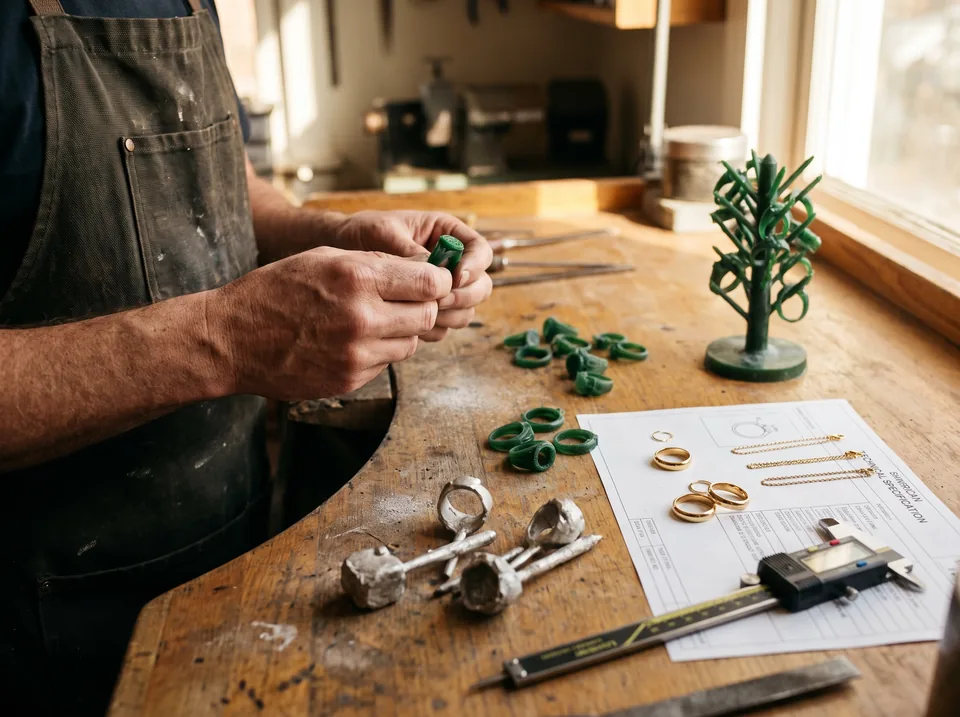
Every cast piece starts as a CAD file, then a printed resin or carved wax model, then usually a rubber mold that makes wax copies for each run. That first sequence is where a new design costs money, and it is the part jewelry manufacturers least often price in public.
We found two published figures. Casting House charges a $100 CAD fee on custom fancy shape ring orders, offers a two day turnaround on standard CAD designs, and takes a non refundable deposit on any new model, mold or CAD drawing for card and cash accounts. Stuller charges a CAM fee per piece and a cancellation fee of $50 to $150 after 90 days. MJJ Brilliant's terms list CAD and design fees as non refundable without giving the amount. Carrera fixes minor file problems at no charge and bills what it calls major surgery.
So the honest way to budget a first collection is per design, not per piece. Ask every maker for four numbers for each new design: CAD, model, mold, and the unit price at two quantities. A design that needs a $100 CAD file and a rubber mold is cheap to test at 10 pieces; a design that needs hand fabrication or a metal mold is not, and you want to know which one you have before you commit.
Who keeps the mold and the CAD file
This is the clause most founders never read. Stuller's CAM service agreement says it retains ownership of any models or molds it creates based on your submitted design, and that it has no obligation to deliver the CAD file. Casting House says it will store your mold, without stating who owns it. The other 11 US makers we read say nothing at all.
Why it matters: your mold is what lets you reorder a bestseller in days, and your CAD file is what lets you take it to another caster. If both stay with the first maker, switching means paying to rebuild them. Put ownership on your first purchase order: the CAD file is delivered to you, molds made for your design are yours, and the maker will ship them on request. Some casters will agree, some will price it, and a few will say no, which is worth knowing before the first run rather than after.
Nobody publishes plating thickness, so you have to write it
Of the 13 US jewelry manufacturers we read, none states a plating thickness in microns for its own work. That leaves the most important spec on a fashion jewelry piece to the buyer, and the FTC Jewelry Guides, 16 CFR Part 23, set the floors your hangtag has to respect.
Gold vermeil must be sterling silver coated with gold of at least 10 karat, with a minimum thickness equivalent to 2.5 microns of fine gold. Because the rule counts fine gold, 12 karat plating needs about 5 microns to reach the same equivalent. Gold filled requires a mechanically bonded layer of at least 10 karat gold making up at least one twentieth of the metal weight; at one fortieth the correct terms are gold plate, gold overlay or rolled gold plate. Gold electroplate needs at least 0.175 microns of fine gold.
Only MJJ Brilliant publishes a vermeil figure, over 2.5 microns, and Essentials Jewelry in Jaipur states 2.5 plus micron vermeil. For stainless steel jewelry, PVD coating is the usual gold finish, and MJJ lists it. Write the karat, the microns and the base metal on the purchase order, and ask for a thickness report on the first lot.
Lead and cadmium rules for jewelry sold in the US
California sets the strictest jewelry rules in the country, and most US brands design to them. Under Health and Safety Code 25214.2, adult jewelry must be made of listed materials such as stainless steel, karat gold, sterling silver and platinum group metals, or keep electroplated or unplated metal under 0.05% (500 ppm) lead, plastic under 0.02% (200 ppm) and coatings under 0.05%.
Children's jewelry, meaning for people under 15 in the California law, is tighter: no more than 100 ppm lead, 90 ppm in surface coatings, and no more than 300 ppm cadmium. Federally, the Consumer Product Safety Improvement Act makes a children's product with more than 100 ppm lead in an accessible component a banned hazardous substance, and the CPSC singles out children's metal jewelry. Children's products also need a Children's Product Certificate.
We do not do regulatory classification. Ask each manufacturer for a material declaration or third party test report for your alloy and plating, keep it on file, and treat any maker that cannot provide one as a risk flag.
A US address is not always a US plant
Several jewelry manufacturers that rank for US searches cast elsewhere, and most say so if you read far enough. MJJ Brilliant has a New York office and a Long Island center, and its production runs in a Mexico facility under USMCA rules, which it markets as duty free. Casting House operates sites in Chicago and Bangkok. Essentials Jewelry has pages titled for US and New York brands and a factory address in Jaipur, India. Mangla International has city pages for New York, Los Angeles and Rhode Island and describes itself as a manufacturer in Jaipur. Custom Fashion Jewels lists a California address for shipping purposes only.
The makers that state in house US production include Empire Casting House (factory on West 46th Street in New York), Kaprielian and AJC Jewelry in Manhattan, Carrera Casting in New York, Lukas Casting House in Los Angeles, Hoover and Strong in Virginia, Stuller in Louisiana, and MCM Technologies and Lee's Manufacturing in Providence, Rhode Island, the historic center of US fashion jewelry. If Made in USA is part of your brand, confirm where the metal is cast and where it is plated, because they are often different places. The same check applies to handbag manufacturers and most other accessory categories.
What to send a jewelry manufacturer for a real quote
Send the same brief to every maker. Include a CAD file or dimensioned drawing, the metal and karat, the plating and its thickness in microns, stones and settings, the finish, and the quantity at two levels, your first run and your 12 month volume. Ask five questions in writing: the minimum, the CAD, model and mold charges per design, the lead time and when the clock starts, who owns the mold and the CAD file, and what lead or cadmium documentation they provide.
The clock start varies more than the lead time. Lukas casts in 1 to 2 business days from the moment it receives your wax models or approved CAD files. Stuller quotes 10 to 15 business days and a resin or wax preview in about three. Hoover and Strong quotes 10 to 14 business days for a new model and mold. Custom Fashion Jewels publishes 2 weeks of development, 3 to 5 days for molds and 3 weeks of production. MJJ quotes 2 to 3 weeks for repeat styles after designs are approved.
Suppliers writes that brief from a plain English description, sends it to the shortlisted manufacturers and keeps their answers side by side. If you are still comparing makers by name, our shortlist of the best jewelry manufacturers for small business ranks them on what they publish. For packaging the finished pieces, see custom packaging manufacturers.
At a glance
What jewelry manufacturers publish, September 2026
| Company | Where it casts | Minimum, as stated | Fees, as stated | Lead time, as stated | Mold or CAD ownership |
|---|---|---|---|---|---|
| Stuller | Lafayette, LA | No minimums; trade account needed | CAM fee per piece; $50 to $150 cancellation after 90 days | 10 to 15 business days; preview in about 3 | Keeps models and molds, stated |
| Casting House | Chicago, IL and Bangkok | No minimum order | $100 CAD fee on custom fancy shape rings | 7 to 10 days; CAD in 2 days | Stores your mold; ownership not stated |
| Carrera Casting | New York, NY | No minimum | Minor file fixes at no charge | Not stated | Not stated |
| Lukas Casting House | Los Angeles, CA | No strict minimum | Offers from 500 g of metal | 1 to 2 business days from wax or CAD | Not stated |
| Hoover and Strong | North Chesterfield, VA | Metal molds for runs over 500 | Not stated | 3 to 4 days for 1 to 20 pieces; new mold 10 to 14 | Not stated |
| MJJ Brilliant | NY office; Mexico production | No minimum order | CAD and design fees non refundable | Repeat styles 2 to 3 weeks after approval | Not stated |
| Custom Fashion Jewels | Granada Hills, CA address (shipping only) | No MOQ on homepage; 50 in FAQ | Not stated | 3 to 5 weeks from design approval | Not stated |
| Empire Casting House | New York, NY factory | Not stated | Not stated | Not stated | Not stated |
| JewelPin | India | 10 pieces per design; $1,000 order | Not stated | Not stated | Not stated |
Read in September 2026 from each company's own website, FAQ, order policy or service agreement; 18 jewelry makers were read and 9 are shown. Not stated means we did not find it on the pages we read, which is the finding rather than an omission. Terms change, so confirm every figure with the manufacturer before you order.
People also ask
The questions buyers actually search.
What is the minimum order quantity for jewelry manufacturers?
At US casting houses there is often none. Stuller, Carrera Casting, Casting House and Lukas Casting House all state no minimum, and Hoover and Strong casts 1 to 20 piece orders. Overseas suppliers set per design floors, such as JewelPin in India at 10 pieces per design with a $1,000 order.
How do I find a jewelry manufacturer for a small business?
Prepare a CAD file or dimensioned drawing, decide the metal, plating thickness and first quantity, then send the same brief to several US casting houses. Ask each for CAD, model and mold charges, lead time, mold ownership and lead test documentation. Suppliers shortlists matching makers and sends that brief for you.
How much does it cost to have jewelry manufactured?
Cost is the metal by weight, per design setup, and labor for casting, finishing, plating and setting. Setup is rarely published: Casting House charges $100 for a custom fancy shape ring CAD, and most makers quote models and molds individually. Ask for the unit price at two quantities to see how much of a small run is setup.
What is the difference between gold plated, gold vermeil, and gold filled?
Under the FTC Jewelry Guides, gold vermeil is sterling silver coated with at least 10 karat gold equal to 2.5 microns of fine gold. Gold filled has a bonded layer of at least 10 karat gold making up one twentieth of the metal weight. Gold electroplate needs only 0.175 microns of fine gold.
Where are jewelry manufacturers located in the USA?
The main hubs are the New York diamond and jewelry district around West 46th to 48th Streets, downtown Los Angeles, and Providence, Rhode Island, the historic center of fashion jewelry. Stuller in Louisiana and Hoover and Strong in Virginia also cast for brands nationwide.
Who owns the mold when a manufacturer makes my jewelry?
Check the contract, because the default often favors the maker. Stuller states it retains ownership of the models and molds it creates from your design and has no obligation to deliver the CAD file. Most other casters say nothing, so put mold and CAD ownership on your first purchase order.
How long does it take to manufacture jewelry?
Casting alone can take 1 to 2 business days at Lukas from receipt of wax or CAD, and 3 to 4 days at Hoover and Strong for small orders. A new design with CAD, model and mold usually takes 10 to 15 business days, and full production runs quoted at 3 to 5 weeks after approval.
Does jewelry sold in the US need lead and cadmium testing?
Children's jewelry must meet the federal 100 ppm lead limit and needs a Children's Product Certificate. California also limits lead in adult jewelry, under 500 ppm for plated or unplated metal, and cadmium in children's jewelry to 300 ppm. Ask your manufacturer for test reports.
FAQ
Common questions.
Yes. State the quantity per design and the metal, and the shortlist prioritizes casting houses whose published terms fit, including US casters that state no minimum.
Yes. Say stainless steel and the finish you want, such as PVD gold, and the agent shortlists makers that work in it. Many stainless steel specialists are overseas, and each match shows where the pieces are made.
No. Suppliers verifies identity, cross-checks registries, surfaces certifications and flags risks. It reduces risk; it does not replace your own sample approval, plating thickness report or lead testing.
Yes. Describe the piece and the agent sends one consistent request for quote to the shortlisted makers, then keeps minimums, setup charges, lead times and mold terms side by side. You review and decide.
Related solutions
Explore more of Suppliers.
Handbag manufacturers
Describe the bag you want made, and the AI shortlists handbag manufacturers with published minimums, sample fees, lead times and pattern terms compared, so you know which workshop fits your first run before you send a tech pack.
Learn more →Custom packaging manufacturers
Describe the box, mailer, or pouch you need, and the AI shortlists custom packaging manufacturers with minimum order quantities, lead times, and finishes compared.
Learn more →Low MOQ manufacturers
Describe what you want made and the quantity you can actually commit to, and the AI shortlists low MOQ manufacturers whose minimum order quantities, unit prices, and lead times fit a first run.
Learn more →Manufacturers for small businesses
Describe what your business needs made, and the AI shortlists manufacturers, suppliers, and vendors that actually take small business orders, with minimums, lead times, and quotes compared side by side.
Learn more →Private label manufacturers
Describe the product you want to sell under your own brand, and the AI shortlists private label manufacturers and suppliers whose published minimum fits your first run, with lead times, fees and certifications compared side by side.
Learn more →Clothing manufacturers
Describe the garment you want made, and the AI shortlists clothing manufacturers with minimum order quantities, lead times, and capabilities compared side by side.
Learn more →Hat manufacturers
Describe the caps or hats you want made, and the AI shortlists hat manufacturers with minimum order quantities, decoration methods, and lead times compared side by side.
Learn more →Manufacturer sourcing
Find manufacturers for your product with an AI agent that vets, shortlists, and compares them for you.
Learn more →All sourcing & procurement solutions
- Procurement software
- AI sourcing agent
- Supplier sourcing
- Manufacturer sourcing
- Supplier discovery
- Supplier management
- Purchase order software
- RFQ software
- Wholesale suppliers
- Cosmetic contract manufacturers
- Supplement contract manufacturers
- Electronics contract manufacturers
- Private label skin care manufacturers
- Co-packers
- Haircare manufacturers
- Clothing manufacturers
- Custom packaging manufacturers
- Candle manufacturers
- Pharmaceutical contract manufacturers
- Medical device contract manufacturers
- Pet product manufacturers
- Pet food manufacturers
- Furniture manufacturers
- Private label manufacturers
- Private label soap manufacturers
- Gummy manufacturers
- Private label coffee roasters
- Activewear manufacturers
- Hat manufacturers
- Sock manufacturers
- Swimwear manufacturers
- Private label perfume manufacturers
- Makeup manufacturers
- US manufacturers directory
- CNC machining companies
- Low MOQ manufacturers
- Manufacturers for small businesses
- Contract manufacturers
- Is Alibaba legit
- Alibaba vs AliExpress
- Alibaba vs Temu
- Custom clothing manufacturers
- Plastic injection molding companies
- Metal fabricators
- Laser cutting services
- Protein powder manufacturers
- Energy drink manufacturers
- Private label lip balm manufacturers
- Private label sunscreen manufacturers
- Softgel manufacturers
- Sauce manufacturers
- Snack manufacturers
- Wire harness manufacturers
- Die casting manufacturers
- Spring manufacturers
- Rubber molding companies
- Handbag manufacturers
- Tote bag manufacturers
- Clothing manufacturers in Mexico
- Vietnam clothing manufacturers
- Beverage co packers
- Factories in Mexico
- Toy manufacturers
- Private label deodorant manufacturers
- Private label chocolate manufacturers
Source your next product
Get a vetted shortlist in minutes.
Describe what you need and get a quote-compared supplier shortlist. Vetted shortlists, quotes compared, no per-deal commission.