HANDBAG MANUFACTURERS
Handbag manufacturers for private label and custom bags
Describe the bag you want made, and the AI shortlists handbag manufacturers with published minimums, sample fees, lead times and pattern terms compared, so you know which workshop fits your first run before you send a tech pack.
| Supplier | Unit | MOQ | Lead | Fit |
|---|---|---|---|---|
Press Source or pick a category to get a vetted shortlist.
The short answer
A handbag manufacturer turns your sketch or tech pack into a paper pattern, a sample and then a production run of bags sold under your brand. Reading 20 bag makers' own sites in September 2026, published US minimums start at 6 bags per style (Rojé Workshop) and 50 totes (Enviro-Tote), typical prototype costs run $500 to $1,500 (Tough Traveler), and overseas factories mostly start at 100 pieces per style. Only one maker we read states in writing that you own your pattern.
Why Suppliers
You have a bag design, maybe a sketch, maybe a sample you bought and took apart, and you want 50 or 200 of them with your name on the lining. The first thing you learn is that most handbag manufacturers do not tell you what that costs. Of the ten US workshops we read, seven publish no minimum, no fee and no lead time at all. The overseas factories publish more, but their minimum is usually 100 pieces per style, and a color change can count as a new style.
This page is built from what bag makers actually put in writing, read on 20 manufacturers' own websites in September 2026, plus the FTC rules that decide what you can print on the hangtag. The pattern is clear. At small volumes a US handbag is priced in hours of labor, not in units. The sample is a real cost you pay before anything sells. And the pattern, the one asset you keep paying for, is rarely addressed at all.
Suppliers is the AI sourcing agent for that search. Describe the bag: the style, the leather or fabric, the hardware, your first run and your target volume, and whether it has to be made in the USA. The agent shortlists handbag manufacturers that match, lays their published terms side by side, and sends one consistent request for quote so the answers come back comparable.
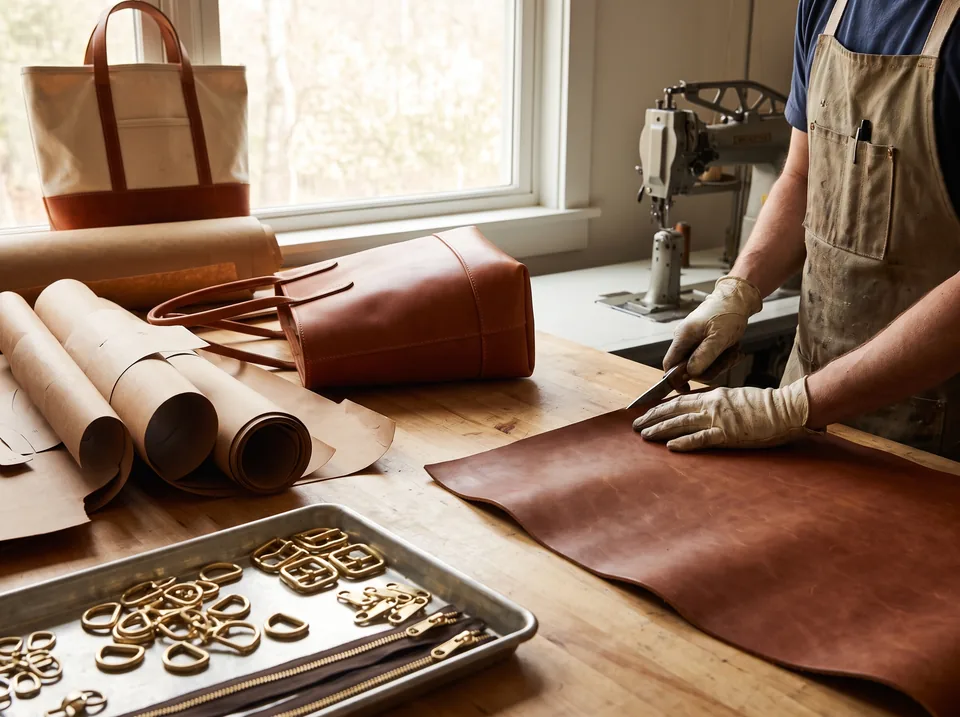
A minimum your first run can meet
Published floors run from 6 bags per style at Rojé Workshop to 300 units at Leeline in China. The shortlist starts from your real quantity instead of the factory default.
Sample cost before you commit
Tough Traveler puts a typical prototype at $500 to $1,500 and Cut and Stitch prices an average sized bag sample from $1,000. The brief asks every maker for the sample fee up front.
Pattern ownership in writing
Only one maker we read says clients own their patterns. The request asks each workshop who keeps the pattern and the dies, so switching factories later stays possible.
Made in USA that holds up
A New York office is not a US factory. Each match shows where the bag is actually cut and sewn, which is what the FTC Made in USA rule looks at.
Material claims checked
The FTC Leather Guides cover handbags. The brief records whether a material is full grain, bonded or vinyl so the hangtag you print is one you can defend.
Flat price, no commission
Suppliers charges a flat monthly fee in USD and takes no cut of your bag order. You contract with the manufacturer directly, and the relationship stays yours.
How it works
Describe, match, decide.
Describe what you need
Type your need in plain English. The agent extracts the structured spec, from quantity and material to target price and destination.
AI finds & vets
It matches qualified suppliers, cross-checks registry and customs data, surfaces certifications, and flags risk, then ranks the fits.
Compare & decide
Review quotes, MOQs, and lead-times side by side, then run RFQ outreach and POs in one place. You stay in control.
Buyer's guide
What to know before you commit.
Small US runs are priced in hours, not in bags
The most useful document we found is Rojé Workshop's private label page, because it shows how a US leather workshop actually bills a small run. Opening orders are 6 bags or 12 small leather goods per style, and labor is billed per hour per bag on a sliding scale: $75 an hour for 1 to 5 bags of a style, $60 for 6 to 11, $55 for 12 to 23 and $50 for 24 or more. It adds that typically 2 to 18 hours are needed to hand cut and assemble each bag.
That range is the whole story of US handbag pricing. A worked model, with the assumption stated: a structured tote that takes 8 hours would carry about $480 of labor per bag at 6 pieces ($60 x 8) and about $400 at 24 pieces ($50 x 8), before leather, hardware and lining. A simple zip pouch at 2 hours would be closer to $100 to $120. The hours are the maker's estimate for your design, so ask for them in writing with the quote.
No other US workshop we read publishes a labor rate. Most quote only after a design review. American Leather Direct in Bowling Green, Kentucky says plainly that you receive the price per unit, the estimated lead time and the minimum order quantity together, after design. That is honest, but it means every quote is a custom number, and the only way to compare two workshops is to send both the same tech pack.
The sample is a real bill, and it comes first
Before a single sellable bag exists, you pay for a pattern and a sample. Three makers publish the number. Tough Traveler in Schenectady, New York, which does all production in house, says prototype costs range from $100 to $10,000, with the typical project in the $500 to $1,500 range. Cut and Stitch prices samples by size: small goods from $500, average sized bags from $1,000, larger bags from $2,000 and complex products from $3,000, including pattern making, sample labor and sourcing advice, with consulting at $200 to $250 an hour. Rojé lists patterns and mockups separately from the first sample on its private label page.
Overseas the sample is cheaper and often refundable. YSK Leather Goods in Guangzhou lists a sample fee of $50 to $200 that it deducts in full on orders of 300 or more and half on 100 to 299. That refund is worth reading carefully: it rewards you for ordering more, which is exactly the decision you are not ready to make yet.
Budget for at least two rounds. A first sample almost always comes back with changes to strap length, pocket placement or edge finish, and every revision is billed. If you already have a finished sample from somewhere else, say so in the brief, because copying a physical bag is faster than drafting from a sketch.
Minimums, per style and per color
US minimums, where published, are low. Rojé starts at 6 bags per style, and says small leather goods carry twice the minimum of handbags. Enviro-Tote in Londonderry, New Hampshire, which cuts, prints and stitches cotton and recycled PET totes in state, sets a 50 piece minimum for printed and unprinted bags and 100 pieces for a custom size. Tough Traveler says it makes everything from single prototypes to runs of thousands. Duluth Pack in Minnesota private labels its own canvas and leather bags, so the starting point is its catalog, not your design, with a one time $150 die fee for your logo.
Overseas minimums cluster at 100. JunHao in Dongguan states a standard MOQ of 100 pieces per single design. HYD Handbags in Guangzhou says selected products may start from 100 pieces per style. YSK lists 100 per style or color, which matters: three colors of one tote can mean 300 bags. Leeline Bags says orders typically start at 300 units.
The color rule is the line item most founders miss. Ask each maker whether its minimum is per style, per color or per material, and whether it will split one minimum across two colorways. Rojé makes the reverse point from the workshop side: 6 bags in the same exotic skin color is more efficient to cut, which is why the tier starts there.
A US address is not a US factory
Several bag makers present a US address and produce elsewhere, and most are open about it once you read far enough. Cut and Stitch has an office on Fifth Avenue in New York and says it uses factories in the USA and internationally, without naming them. Bag Manufacturer USA gives a Beverly Hills headquarters and lists factories in the USA, Spain, Turkey, India, Bangladesh and China. Baikal in Manhattan offers domestic and overseas production.
None of that is a problem on its own. It becomes one when you print Made in USA. The FTC Made in USA rule, 16 CFR Part 323, allows that claim only when final assembly happens in the United States, all significant processing happens here, and all or virtually all components are made and sourced here. A bag sewn in New Jersey from imported leather and hardware may not qualify for an unqualified claim, so ask the maker which parts are imported before you design the label.
The makers we read that state US production in plain words are Tough Traveler (all production in house in the USA), Enviro-Tote (cut, printed and stitched in New Hampshire), Duluth Pack (made in Minnesota), American Leather Direct (Kentucky), CustomFab USA (Anaheim and Arizona), Lefty Production Co. in Los Angeles and Park Avenue Trimming in New York. If you import instead, an Alibaba sample order is the usual way to test an overseas factory before a production deposit.
Who owns the pattern when you leave
Your pattern is the part of a bag you pay to develop and the part that lets you move production later. Of the 20 makers we read, exactly one addresses it in writing. Rojé says clients own these works exclusively and that it never holds your patterns hostage. CustomFab USA, a contract sewing shop that includes bags and luggage, tells buyers to make sure the agreement clarifies ownership of patterns and prototypes, which is good advice and also a sign that the default is not settled.
Everyone else is silent, including every overseas factory we read. Duluth Pack stores your logo die for reuse, which is convenient and also means the die lives at Duluth Pack. Put three lines on your first purchase order: the pattern files and cutting dies are yours, the maker will release them on request, and your design will not be sold to anyone else. It costs nothing to ask before the deposit and a great deal to argue about after a bestseller.
Leather, vinyl and what the hangtag can say
Handbags are named directly in the FTC Guides for Select Leather and Imitation Leather Products, 16 CFR Part 24, which cover ladies' handbags, shoulder bags, purses, pocketbooks and luggage. Under those guides it is deceptive to use the unqualified word leather unless the product is made in all substantial parts of leather. Material that looks like leather and is not must be disclosed, for example as not leather, imitation leather or vinyl, and bonded or reconstituted leather should not be called leather without qualification.
If you sell PVC or vinyl bags into California, Proposition 65 is the other rule to plan for. A 2024 settlement over a vinyl purse defined DEHP free as 0.1% by weight or less, and the California Attorney General has pursued lead and DEHP in handbags, wallets and belts before. Ask a vinyl or PU supplier for a material declaration or test report on phthalates and lead, and keep it on file.
We do not do regulatory or tariff classification. If you import finished bags, the duty rate depends on the outer material, and paying through Alibaba Trade Assurance protects the order, not the classification. Confirm both with your broker before the first shipment.
What to send a handbag manufacturer for a real quote
Send the same brief to every maker. It should include a tech pack or a physical sample, dimensions, the outer material and its grade, the lining, the hardware finish and whether you supply it, the logo method (stamp, emboss, metal plate or print), your first run and your 12 month volume, and the number of colors. Ask four questions in writing: the minimum per style and per color, the sample fee and whether it is refundable, the lead time and the date the clock starts, and who owns the pattern and the dies.
The clock start matters more than the lead time. Rojé quotes less than 60 days from the finalized purchase order and pro forma invoice, with a 50% deposit to start production. Enviro-Tote quotes 7 weeks for printed totes and 4 weeks for unprinted, counted once you have approved the order, the art proof and the ship date. CustomFab USA gives a usual window of 4 to 6 weeks. Leeline states 15 to 20 business days, with 7 to 10 days for a 15% surcharge. None of those clocks starts when you first email.
Suppliers writes that brief for you from a plain English description, sends it to the shortlisted manufacturers and keeps their answers side by side, so a US workshop billed by the hour and an overseas factory billed by the piece can be compared on the same order. If you are building a fuller apparel line, the same approach works for custom clothing manufacturers and hat manufacturers.
At a glance
What handbag manufacturers publish, September 2026
| Company | Where it makes bags | Minimum, as stated | Fees or prices, as stated | Lead time, as stated | Pattern ownership |
|---|---|---|---|---|---|
| Rojé Workshop | US workshop (city not stated) | 6 bags or 12 small leather goods per style | $75 to $50 per labor hour per bag by tier; 2 to 18 hours per bag | Under 60 days from final PO; 50% deposit | Client owns it, stated |
| Tough Traveler | Schenectady, NY, all in house | From a single prototype | Prototypes $100 to $10,000, typically $500 to $1,500 | Not stated | Not stated |
| Enviro-Tote | Londonderry, NH | 50 totes; 100 for custom sizes | $35 per color, per image, per side; sample from $50 | 7 weeks printed, 4 unprinted, after approval | Not stated |
| CustomFab USA | Anaheim, CA and Arizona | Varies by project | Not stated | Usually 4 to 6 weeks | Advises you to put it in the contract |
| Duluth Pack | Duluth, MN | Not stated; your logo on its bags | $150 one time logo die fee | A number of weeks | Stores your logo die |
| American Leather Direct | Bowling Green, KY | Quoted after design | Quoted after design | Quoted after design | Not stated |
| Cut and Stitch | NYC office; US and overseas factories | Not stated | Samples from $500 small to $3,000 complex | Not stated | Not stated |
| JunHao | Dongguan, China | 100 pieces per design | Not stated | 7 day sampling for regular styles | Not stated |
| YSK Leather Goods | Guangzhou, China | 100 per style or color | Sample $50 to $200, refunded at 300 or more | Not stated | Not stated |
| Leeline Bags | Wuhan office, China | Typically 300 units | Not stated | 15 to 20 business days; faster for 15% to 25% more | Not stated |
Read in September 2026 from each company's own website; 20 bag makers were read and 10 are shown. Not stated means we did not find it on the pages we read, which is the finding rather than an omission. Terms change, so confirm every figure with the manufacturer before you order. The labor cost model in the guide above is a worked example with stated assumptions, not a quote.
People also ask
The questions buyers actually search.
How much does it cost to manufacture a handbag?
At small US volumes the answer is mostly labor. Rojé Workshop bills $50 to $75 per hour per bag depending on quantity and says a bag takes 2 to 18 hours, so labor alone runs roughly $100 to $1,350 per bag before materials. Overseas, YSK lists canvas totes from about $18 to $32 at 100 units.
What is the minimum order for a handbag manufacturer?
Published minimums start at 6 bags per style at Rojé Workshop and 50 totes at Enviro-Tote in New Hampshire. Most overseas factories start at 100 pieces per style, and YSK counts each color separately, so three colors can mean 300 bags. Leeline typically starts at 300 units.
How do I find a manufacturer for my handbag line?
Prepare a tech pack or a physical sample, decide your material, hardware and first quantity, and send the same brief to several makers so the quotes compare. Ask each for the minimum per style and color, the sample fee, the lead time clock start and who owns the pattern. Suppliers shortlists matching makers and sends that brief for you.
How much does a handbag sample cost?
Tough Traveler puts a typical prototype at $500 to $1,500, and Cut and Stitch prices an average sized bag sample from $1,000 and a complex one from $3,000. Overseas samples are cheaper: YSK lists $50 to $200 and refunds it on larger orders. Budget for at least two sample rounds.
Are there handbag manufacturers in the USA?
Yes. Makers that state US production include Tough Traveler in Schenectady, New York, Enviro-Tote in New Hampshire, Duluth Pack in Minnesota, American Leather Direct in Kentucky, CustomFab USA in California and Arizona, and workshops in Los Angeles and New York. Check where a maker sews, not where its office is.
Can I label my bag Made in USA?
Only if final assembly and all significant processing happen in the United States and all or virtually all components are US made and sourced, under the FTC rule at 16 CFR Part 323. A bag sewn in the US from imported leather or hardware may need a qualified claim, so ask your maker what is imported.
Who owns the pattern for my handbag design?
Unless your contract says so, it is often unclear. Of 20 makers we read, only Rojé Workshop states that clients own their patterns. Put pattern files, cutting dies and a release on request into your first purchase order, before you pay the deposit.
How long does it take to manufacture handbags?
Published figures run from 4 to 6 weeks at CustomFab USA and 4 to 7 weeks at Enviro-Tote after approval, to under 60 days at Rojé after the purchase order is finalized. Leeline in China quotes 15 to 20 business days. Add sampling time before any of those clocks start.
FAQ
Common questions.
Yes. State the quantity you can commit to per style and per color, and the shortlist prioritizes makers whose published or quoted minimums fit it, including US workshops that start at a handful of bags.
Each match shows where the maker says the bags are cut and sewn, with identity checks and the evidence behind them. Confirm the factory address in writing before you print a Made in USA claim.
No. Suppliers verifies identity, cross-checks registries, surfaces certifications and flags risks. It reduces risk; it does not replace your own sample approval or a third party inspection.
Yes. Describe the bag or attach your details, and the agent sends one consistent request for quote to the shortlisted makers, then keeps minimums, sample fees, lead times and pattern terms side by side. You review and decide.
Related solutions
Explore more of Suppliers.
Custom clothing manufacturers
Describe the garment you want made to your own design, and the AI shortlists custom clothing manufacturers and cut and sew factories with minimum order quantities, lead times, and quotes compared side by side.
Learn more →Clothing manufacturers
Describe the garment you want made, and the AI shortlists clothing manufacturers with minimum order quantities, lead times, and capabilities compared side by side.
Learn more →Hat manufacturers
Describe the caps or hats you want made, and the AI shortlists hat manufacturers with minimum order quantities, decoration methods, and lead times compared side by side.
Learn more →Jewelry manufacturers
Describe the piece you want made, and the AI shortlists custom jewelry manufacturers with published minimums, CAD and casting terms, lead times and mold ownership compared, so a small brand knows which caster fits before it sends a design.
Learn more →Activewear manufacturers
Describe the leggings, tops, or performance pieces you want made, and the AI shortlists activewear manufacturers with minimum order quantities, performance fabrics, and lead times compared side by side.
Learn more →Low MOQ manufacturers
Describe what you want made and the quantity you can actually commit to, and the AI shortlists low MOQ manufacturers whose minimum order quantities, unit prices, and lead times fit a first run.
Learn more →Private label manufacturers
Describe the product you want to sell under your own brand, and the AI shortlists private label manufacturers and suppliers whose published minimum fits your first run, with lead times, fees and certifications compared side by side.
Learn more →Manufacturers for small businesses
Describe what your business needs made, and the AI shortlists manufacturers, suppliers, and vendors that actually take small business orders, with minimums, lead times, and quotes compared side by side.
Learn more →All sourcing & procurement solutions
- Procurement software
- AI sourcing agent
- Supplier sourcing
- Manufacturer sourcing
- Supplier discovery
- Supplier management
- Purchase order software
- RFQ software
- Wholesale suppliers
- Cosmetic contract manufacturers
- Supplement contract manufacturers
- Electronics contract manufacturers
- Private label skin care manufacturers
- Co-packers
- Private label shampoo manufacturers
- Clothing manufacturers
- Custom packaging manufacturers
- Jewelry manufacturers
- Candle manufacturers
- Pharmaceutical contract manufacturers
- Medical device contract manufacturers
- Pet product manufacturers
- Furniture manufacturers
- Private label manufacturers
- Private label soap manufacturers
- Gummy manufacturers
- Private label coffee manufacturers
- Activewear manufacturers
- Hat manufacturers
- Sock manufacturers
- Swimwear manufacturers
- Private label perfume manufacturers
- Makeup manufacturers
- US manufacturers directory
- CNC machining companies
- Low MOQ manufacturers
- Manufacturers for small businesses
- Contract manufacturers
- Is Alibaba legit
- Alibaba vs AliExpress
- Alibaba vs Temu
- Custom clothing manufacturers
- Plastic injection molding companies
- Metal fabricators
- Laser cutting services
- Protein powder manufacturers
- Energy drink manufacturers
- Private label lip balm manufacturers
- Softgel manufacturers
- Sauce manufacturers
- Snack manufacturers
- Wire harness manufacturers
- Die casting manufacturers
- Spring manufacturers
- Rubber molding companies
Source your next product
Get a vetted shortlist in minutes.
Describe what you need and get a quote-compared supplier shortlist. Vetted shortlists, quotes compared, no per-deal commission.